
What I've learned from therapy.
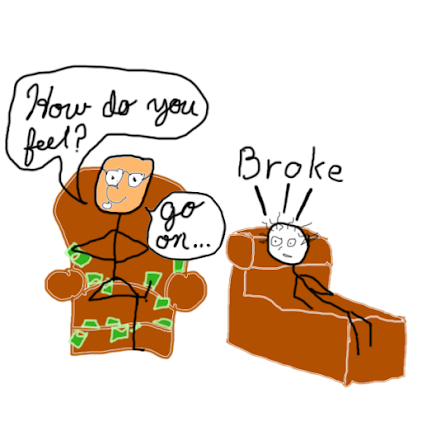
In the past 8 years I’ve attended over 600 therapy sessions and spent $239,874 on my mental health. Here’s what I’ve learned…
The process of improving my outlook on life, or maybe just accepting my outlook on life, is not a straight forward one. Many times my problem is not that life is genuinely horrible, but my view of it has become so narrow that I’m incapable of experiencing anything but neurosis.
Jung once said “Neurosis is always a substitute for legitimate suffering.” Essentially there is some wounding, suffering, or otherwise neglected feeling, often because it is to difficult to bear, so instead we suffer in some other way.
Part of the difficulty of experiencing that actual suffering is that it may come with revealing to to me something that I do not like. For instance I have to realize the reason I’m suffering from a break up where I cannot understand the persons actions might actually be because of how ugly and selfish I have been. Looking at reality honestly is to hard for me to do on my own, so instead I build a story around it to cover it up. The story sits on top of the actual wound which remains unexpressed and I continue with life. Pretty good right?
Wrong. As I continue to navigate life with this explanation about how the world is or who I am start to bump into contradictions that negate my perspective. At this point instead of realizing I’m wrong, letting go of my story, and experiencing the true pain that brought me to this point I instead double down and become defensive. I find a new way to explain why the world works this way that fits my story. Or maybe I alter my story in a way that updates it but still moves me further into denial. Either way instead of accepting the truth, I bury it further.
As I continue through life with this mentality of revising or explaining the world in a way that I bury my pain the surface area of my faulty explanation grows and becomes more complicated. This inaccurate way of explaining the world, in which I have invested a lot of energy, is referred to as a complex. It becomes very important that defend the complex because it protects from my pain. As this process unfolds over years my ability to navigate the world without bumping into a conflict becomes impossible.
As a consequence of hanging on to my faulty view of the world I ultimately become bitter and resentful. I hate life because I think by and large it has betrayed me. All of my relationships become unmanageable because I’m impossible to interact with. I get angry at any small inconsistency with my story. Often these inconsistencies are too small for anyone else to notice or understand. As I become bitter my soul starts to become brittle. I cannot not tolerate looking around at the world to see life’s beauty. I instead keep my head down avoid having to address another conflict within myself. I then follow this process ad nauseam for the rest of life and then I die unhappy and alone!
The voice that kicks and screams in my head, the complex, does not provide any new or useful information yet it’s loud and I struggle to ignore it. It’s like a child throwing a temper tantrum because it wants to be right even though it’s wrong. If the complex is loud enough and annoying enough the hope is that you’ll just give into it’s demands. It’s mental health terrorism. Approaching the complex alone is possible for some to resolve on their own but if it’s deeply ingrained enough it can be difficult to differentiate the complex from myself. As a consequence I conclude that I hate this aspect of me and thus hate myself. For me approaching the complex by myself is dangerous.
In comes therapy. Therapy doesn’t solve the problem the complex presents. The complex is intended to be unsolvable. Therapy also does not satiate the complex either. The complex will never be satisfied. Instead, in my experience, therapy invalidates the complex. This is done by approaching the complex together. The therapist holds space for me to expel all my inner voices. I am not judged in this process, which is important for building the trust that allows me to display more and more of my inner world. This process takes time and does not come out all at once, but rather as trust is built.
When I first started working with my therapist I had no face to save. I knew I was fucked on my own and given any more time of doing what I was up to I was undoubtedly going to kill myself. I needed help. Despite that I at the same time had a hard time taking ownership for the idea that I might be part of my problem. It’s amazing how quickly the complex would attempt to hide. It’s amazing how quickly I would become embarrassed of my pettiness.
Therapy becomes a game of hide and seek with my problems. I have arrived on this couch because I have a problem, but when I open my mouth to speak my problems seemingly disappear. This is why it takes time to be effective. Some days I just blather on about nothing it seems and that’s when my invalid story comes to the top. My first inclination is denial. “That’s not what I meant.” or defensiveness “you’re framing it to look bad.” Over time I arrive at “You’re right.” Over time I get to know my own stories and see their inconsistencies with reality.
Bumping into the complex often doesn’t feel good. I had a friend ask once “Do you always feel better after therapy?” My response was a resounding “No.” In fact you often know therapy is being effective when negative feelings are coming up. It’s not uncommon that the effect is that it arouses enough negative emotion that I then have to follow up with self soothing after. This is a good thing.
As the complex is approached and bumped into and invalidated not as inherently false, “That’s so stupid why would you ever think that? You’re an idiot!”, but rather through a form of acceptance that it was a story I needed at the time to navigate the world I was in. A world that no longer exists. This process continued for me biweekly at first and then weekly later on.
The process sort of looks like this as the back and forth happens:








The complex never goes away. However over time you develop an understanding of these false stories and learn not to trust them. It’s possible to identify, recognize that it’s happening, then realize that it offers no new nor useful information. At that point I can choose to not engage with it.
Over time as my primary wounding, which was taking up the bandwidth of my emotional capacity, has been relieved I now have space for other feelings and experiences. I’m able to lift my head and see the world. I can chase after new experiences. If those experiences trigger negative emotions they may bring up old stories. I then attempt, with best efforts, to acknowledge and discard them.
It doesn’t always go smoothly and sometimes they still result in permanent changes or negative effects in my life. It’s not a perfect process, but it does get better over time. As I am able to engage different emotions and experiences my soul stops being so brittle and starts becoming more supple. I become flexible in how I engage life and I can now revel in life’s beauty once again.
Comments
Post a Comment